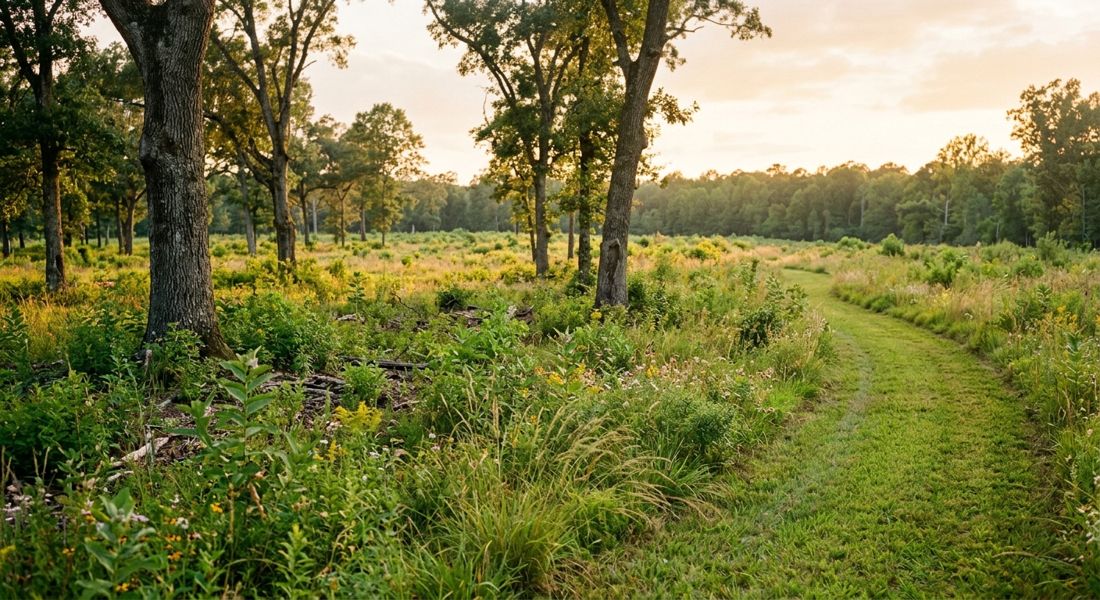

Early successional habitat.
Most of what a deer eats grows in the first five feet above the ground, and it only grows where sunlight reaches. We open the canopy on purpose, cut cover so deer can use it, and come back on a rotation so the ground stays productive.
Under a closed canopy there is almost nothing to eat.
A mature stand with a closed canopy shades out the ground layer. The browse, forbs, and soft mast that deer live on need light, and a closed stand does not let much through. Forage studies across the Southeast put closed-canopy woods at roughly 20 to 100 pounds of deer forage per acre per year. The same ground opened up and held in early succession produces 500 to 2,000 pounds. A deer eats close to a ton a year.
Pine plantations show the same pattern on a clock. In Mississippi Coastal Plain loblolly, nutritional carrying capacity ran about 10 to 13 deer-days per acre in the first three years after planting and fell to under half a deer-day per acre when the canopy closed around year seven. It stayed there until the first thinning let light back in.
What early succession means.
When the canopy opens, the ground goes through a sequence. Bare soil comes up in annual forbs and grasses the first year. Perennial forbs, brambles, and shrubs take over in years two through four. Saplings and thicket follow, and within a decade the canopy closes again and the cycle stops. Early succession is the first few years of that sequence: the stage with the most food and the most cover at deer height.
Forage peaks two to three years after the canopy opens and declines from there. The plants that come up are mostly already in the ground. Research on restored native plant communities found native forb cover increased by 47.5 percent when the existing seed bank was released with fire, and concluded that planting was unnecessary on most sites. Deer are not the only ones that respond. Insects from a forb layer make up about 80 percent of a turkey poult’s diet, and bobwhite quail need the bare ground and overhead cover that only this stage provides.
Controlled disturbance.
Early succession does not last. That is its definition. Something has to set the woody growth back before the canopy closes, and for most of this country’s history that was fire, flood, storms, and grazing animals. Managing for early succession means choosing the disturbance and controlling where it happens, when, and how hard.
Prescribed burning
The original tool, and the best one where it can be used. In Louisiana a burn runs under a written burn plan, with a certified prescribed burn manager on site from ignition until the burn is declared safe, and with notice to the Office of Forestry. Neighbors, smoke, and weather windows decide whether fire is practical on a given tract.
Managed grazing
Cattle worked the brush down long before machines did. A rotational grazing system can hold open ground open and turn habitat work into a working pasture. We design and consult on these systems as part of our working-lands work.
The forestry mulcher
The tool for ground where fire is not an option: small tracts near houses, no burn window, heavy stems, tallow and privet thickets. A mulching head grinds standing brush back onto the soil in place. Roots, seed bank, and the good trees stay. It can be aimed at one acre and stopped at the next.
On a rotation. Openings are set back every two to four years, depending on how the plants respond. Hardwood stands thinned for wildlife hold their forage on a three to five year return. The work is staggered so that a third of the managed ground is in each stage at any time, and it is timed outside fawning and nesting season. The site tells you when it is ready, not the calendar.
What grows back matters. Chinese tallow and privet resprout from stumps and lateral roots after cutting, and repeated mowing can leave tallow thicker than before. Any plan that includes those species pairs the cut with a herbicide follow-up on the stumps and sprouts, so the native seed bank wins the opening instead of the invasive.
Cover deer can actually use.
A cutover that grows into a solid wall of thicket is full of food, and deer cannot get to most of it. Deer avoid pushing through cover they cannot move in. If you cannot walk through it, they mostly will not either. The fix is not to clear it. The fix is to cut what they need through it.
Travel corridors cut through heavy cover, with the cut brush left along the edges as browse, connect bedding to food. Deer take the easy line, and a lane puts that line where you want it.
Small openings in thick regeneration let sunlight in and give deer a place to feed inside cover. Too small and they do not get enough sun; the plan sizes them to the stand.
Where timber meets a field, dropping trees 15 to 20 yards back into the stand turns a hard wall into a band of browse and fawning cover that deer will use at all hours instead of only after dark.
Core blocks of thick cover stay uncut. Deer need a few of them per tract. The rest of the ground works around those blocks, not through them.
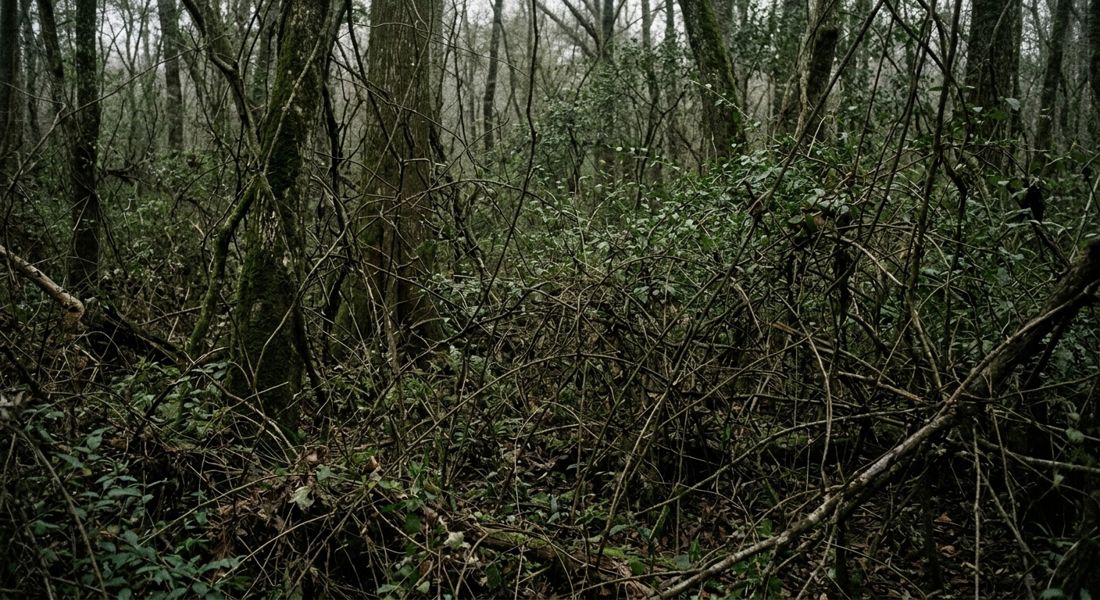
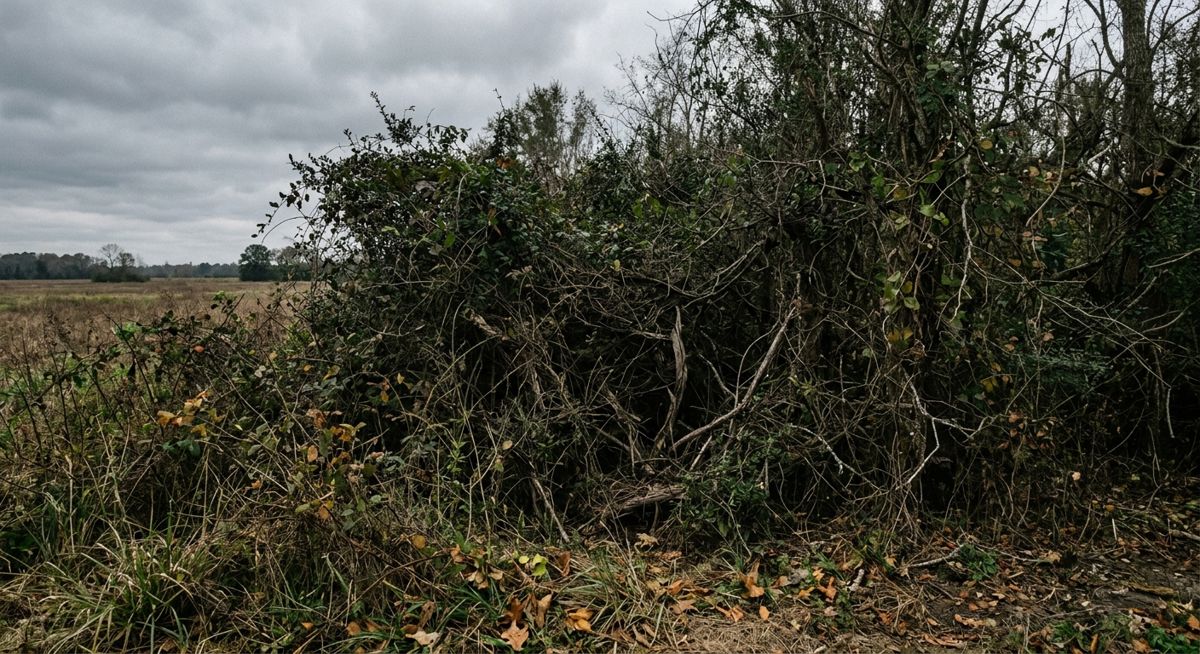
The structure to aim for is a mix of stages, not one big opening: roughly a third of the tract in mature timber, a third in early succession, and a third in brushy regeneration, with thick cover never more than about a hundred yards from the next patch.
Opening the canopy in standing timber.
You do not have to clear-cut to get light on the ground. In a loblolly stand, thinning to a basal area of 60 to 80 square feet per acre balances timber growth with wildlife; going below 50 makes savanna-type habitat at the cost of some wind risk. In hardwoods, a Tennessee study found that reducing the canopy and following with fire more than tripled the forage on the ground compared with untreated stands.
The overstory cut is a timber sale, and it belongs to your forester or logger. The midstory, the understory, the invasive control between the crop trees, and the return visits on rotation are ours. Cost-share for this kind of work exists through NRCS practices such as Forest Stand Improvement, Brush Management, and Early Successional Habitat Development. Rates are set each year and depend on the ranking; we can help you sort out what applies to your ground.
How it works.
Assess
Walk the ground, map it by drone, and count the herd if the numbers matter to the plan. See what the property is actually holding.
Plan
A written plan on a drone basemap: which acres, which tool, what rotation, what stays. Every cut has a reason before the machine starts.
Disturb
Mulch, cut, or burn where it is permitted, on the acres the plan calls for. Treat the resprouts so the right plants win.
Come back
Photograph what returned, re-count if we counted, and set the next block back on schedule. The plan runs for years, not one season.
This is the work behind the Habitat Reset. A thermal deer survey tells you whether the herd is above what the ground can feed. Succession work is how you raise what the ground can feed.
Frequently asked questions.
How much of my property should be in early succession?
A common guideline for forested land is about a third of the acreage in early succession, a third in brushy regeneration, and a third in mature timber, spread across the tract rather than in one block. Smaller properties still benefit from even a few well-placed openings. The plan sets the acreage to your goals, your timber, and what the ground is already doing.
When is the best time to do this work?
Mulching runs best from late summer through winter, when the ground is firm and the work is out of fawning and nesting season. Burns go in during the dormant season or early spring under a burn plan. If deer season is running on the property, the machine work is scheduled around it.
Won’t it just grow back?
Yes, and that is the design. The plants that come back in the light are the point. The plan sets the ground back again every two to four years so it never closes over. The exception is invasives: tallow, privet, and similar species resprout from the roots and need a herbicide follow-up after the cut, or the opening fills with the wrong thing.
Does opening the canopy hurt my timber?
Done selectively, no. The crop trees stay and grow faster with less competition. Thinning to 60 to 80 square feet of basal area per acre is a standard timber-and-wildlife balance in pine. Thinning heavier than that is a wildlife decision with some wind risk, and we will say so before it happens.
Is this only for deer?
No. Turkey poults live on the insects that a forb layer produces. Quail need the bare ground and overhead cover of early succession, and the loss of that stage is the main reason bobwhite numbers have fallen across the South. Native bees and songbirds respond to the same structure. Deer are usually what the landowner asks about first; the rest come with them.
Is there cost-share for this?
Often. NRCS conservation practices cover early successional habitat development, forest stand improvement, brush management, and prescribed burning, and Louisiana’s EQIP program lists wildlife habitat among its priorities. Payment rates are set each year and depend on the application. We can help you figure out what your ground qualifies for.
How is this priced?
As a plan and a program, priced to the property, not by the hour. Acreage, stem density, access, and how much of the work is machine versus follow-up all move the number. We look at the ground first.
Sources
- Turner, M.A., et al. 2026. Management scale and intensity limit forage availability on properties managed for white-tailed deer. Journal of Wildlife Management (summarized by the National Deer Association, deerassociation.com).
- Lashley, M.A., Harper, C.A., Bates, G.E., Keyser, P.D. 2011. Forage availability for white-tailed deer following silvicultural treatments in hardwood forests. Journal of Wildlife Management 75(6):1467-1476.
- Mississippi State University Deer Ecology & Management Lab. Forest Management (msudeer.msstate.edu).
- Masters, R., Stewart, M. White-Tailed Deer. Oklahoma State University Extension.
- Powell, et al. 2025. Changes in plant composition following disturbance in restored native plant communities. Rangeland Ecology & Management 98:480-489.
- Harper, C.A. 2007. Strategies for managing early succession habitat for wildlife. Weed Technology 21(4):932-937.
- Turner, M.A., Harper, C.A. 2024. Understory composition and structure influences deer and turkey habitat in southern pine stands. Southeastern Naturalist 23(2):175-193.
- USDA NRCS Conservation Practice Standards 647 (Early Successional Habitat Development/Management), 666 (Forest Stand Improvement), 314 (Brush Management), 338 (Prescribed Burning).
- Bradley, S., Kush, J. Thinning loblolly pine stands to benefit wildlife and timber production. Alabama Cooperative Extension System.
- Haley, N. 2024. Turkey habitat management. Alabama Cooperative Extension System.
- Hamrick, R., et al. Ecology and management of the northern bobwhite. Mississippi State University Extension P2179.
- Loewenstein, N., Russell, D., Enloe, S. Management options for Chinese tallowtree. Alabama Cooperative Extension System. Lemus, R. Chinese tallowtree. MSU Extension P3185. Byrd, J., Maddox, V. Chinese privet. MSU Extension P3207.
- Louisiana Revised Statutes 3:17 (prescribed burning); Louisiana Department of Agriculture and Forestry, Prescribed Burning program.
- Maine Department of Inland Fisheries and Wildlife. 2023. Managing your habitat for white-tailed deer: a small woodlot owner’s guide.