
Forestry mulcher or dozer: what each one leaves behind.
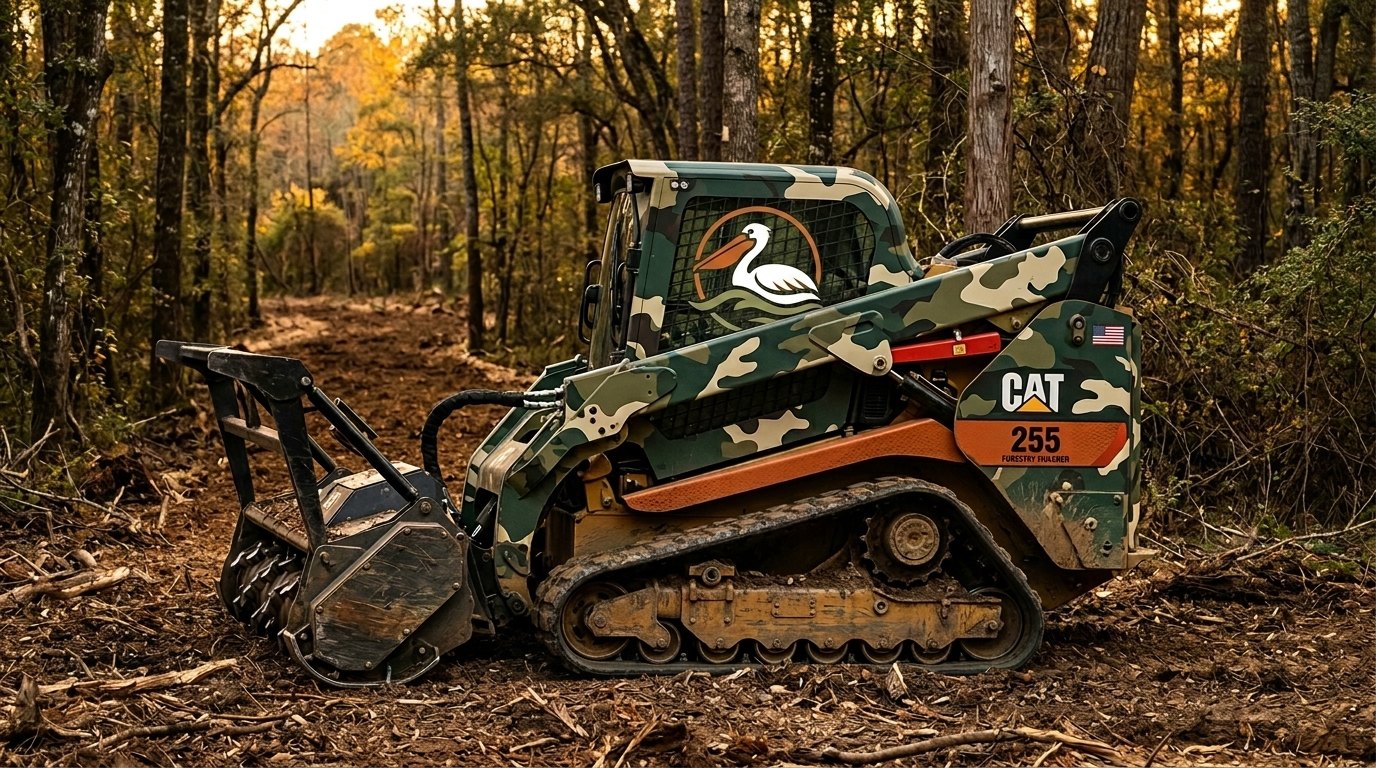
There are two common ways to open up overgrown ground in South Louisiana. One is a dozer, usually with a root rake, pushing everything into piles to burn or haul. The other is a forestry mulcher, a tracked machine with a grinding head that turns standing brush and small trees into a layer of chips where they stood. Both get you open ground. The difference is what you are standing on when the machine leaves.
This is a plain comparison of the two, with the numbers we could find from extension services and the Forest Service, and an honest section on when the dozer is the right call.
What a dozer does to the ground
A dozer clears by pushing. The blade or the rake takes the tree, the stump, and the root ball, and it takes the top of the soil with them. Virginia Cooperative Extension’s land clearing guide puts it simply: bulldozing “nearly always destroys the topsoil,” because a significant amount of it goes out with the roots. That matters more than it sounds. Most of the fertility, the organic matter, the soil life, and the native seed bank sit in those top few inches, and the Soil Science Society of America’s figure for rebuilding one inch of topsoil is 500 to several thousand years.
What is left is bare mineral soil, compacted by repeated passes of a machine that weighs three times what a compact track loader weighs. Clemson’s review of equipment traffic on forest soils found bulk density rises as much as 50 percent in the first three passes and porosity drops as much as 60 percent, which means less water soaking in and roots that cannot push through. In the South, without freeze-thaw cycles to loosen it, that compaction can take decades to recover on its own. Loblolly seedlings on compacted skid trails grew 40 to 50 percent shorter in their first year than seedlings on undisturbed ground.
Bare ground also moves. Oklahoma State’s erosion guidance puts a freshly disturbed site at 100 to 500 tons of soil loss per acre per year, roughly 2,000 times the rate under woodland. On a Louisiana tract that means the first hard rain after a dozer clear carries part of the property into the nearest ditch.
Then there are the piles. Burning brush piles is legal in Louisiana for land clearing, with conditions: at least 1,000 feet from any off-site dwelling, between 8 a.m. and 5 p.m., wind away from populated areas, and as little dirt in the pile as possible. Parish burn bans override all of that. The heat under a pile volatilizes nitrogen and cooks the soil life for hours, and what does not burn completely has to be re-piled or hauled. The scar under a burn pile is small, but it lasts.
What a mulcher does to the ground
A forestry mulcher does not push anything. The head grinds standing brush and small trees from the top down and lays the chips on the ground in place. The roots stay in the soil, holding it together. The stumps are cut flush and rot where they are: three to five years for pine, longer for hardwoods. The topsoil is never turned over or moved, so the seed bank that was in it is still there when the light hits it.
The machine matters too. Our track loader runs 4.7 psi of ground pressure on wide tracks, lighter than a person standing. To be fair to the dozer, a low-ground-pressure dozer can match that number on paper. The compaction difference comes from what the two machines do, not just what they weigh: a mulcher drives over its own chip layer instead of bare mineral soil, and the Forest Service’s review of mastication studies found compaction from machines driving on masticated residue was insignificant.
The chip layer
The layer of ground-up wood the mulcher leaves behind is the whole point. It is mulch, and it behaves like mulch.
- Moisture and temperature. Washington State University’s review of wood chip mulch found it among the best performers for holding soil moisture and moderating soil temperature. The Forest Service found the same for masticated residue: it buffers temperature extremes and acts as a mulch over the ground it covers.
- Nutrients, slowly. Wood chips break down over years, not weeks, and release their nutrients to the soil as they go. Most mastication studies found no drop in soil carbon or nitrogen, and several found more plant-available nitrogen on masticated sites.
- Erosion. A chip layer holds seed in place, slows runoff, and gives whatever germinates a better start than bare dirt.
- The nitrogen question. Fresh wood chips do tie up nitrogen, but at the boundary between the chips and the soil, and mostly when chips are mixed into the soil rather than left on top. A surface layer that stays on the surface is not the problem people worry about. Left alone for a growing season, it settles into the ground like a forest floor.
- Depth is the variable. The same Forest Service review found that plant cover and species richness went to zero where the residue was deeper than 4 inches, and did best between zero and 2 inches. That is a technique question. A good operator leaves a thin, even layer, not a mat, and does not run a thicket into a pile of chips.
The seed bank
This is the part most people do not think about. The soil under an overgrown stand is full of seed from the plants that grew there before the canopy closed, waiting on light. Work from the University of Tennessee on restoring native plant communities found that releasing the existing seed bank with disturbance raised native forb cover by 47.5 percent, and that planting was unnecessary on most sites. The plants you want are usually already in the ground.
A mulcher leaves that seed bank where it is and then gives it sunlight. A dozer scrapes it off with the topsoil, and what you get on bare subsoil is whatever blows in or whatever you pay to seed. If the goal is habitat, that difference is the difference between a cutover that comes up in browse and forbs and one that comes up in bare dirt and then tallow. There is more on what happens after the canopy opens on our early succession page.
What grows back
Both methods leave you with regrowth. The question is which regrowth. After a mulch cut, the native seed bank comes up alongside the resprouts from whatever was cut, and on most Louisiana ground that includes Chinese tallow and privet. Both resprout from stumps and roots. Alabama Extension’s tallow guidance notes that repeated mowing can leave tallow thicker than before, because a cut stem becomes several. A mulch job that includes tallow or privet needs a herbicide follow-up on the stumps and sprouts, or the native plants lose the opening. We plan that follow-up into the job, and we say so up front.
A dozer clear has the same resprout problem on any root fragments left behind, with none of the native competition to slow the invasives down.
Cost
Numbers vary a lot with stem size, density, terrain, and access, so treat any per-acre figure as a range. The one head-to-head extension trial we found, from Virginia Tech’s Southern Piedmont research center, came in at $850 per acre for mulching against $1,650 per acre for conventional clearing. Industry cost guides put mulching below dozer work on a per-acre basis as well, mostly because there is no piling, no burning, no hauling, and no regrading afterward. Where a dozer wins on cost is heavy timber with large stumps that have to come out anyway, and that is a different job.
| Forestry mulcher | Dozer and root rake | |
|---|---|---|
| Topsoil | Stays in place, undisturbed | Displaced with the roots; often lost |
| Roots and stumps | Roots stay; stumps cut flush and rot | Pulled out; ground has to be regraded |
| Seed bank | Intact, released by sunlight | Scraped off with the topsoil |
| Debris | Chip layer left as mulch | Piled to burn or haul |
| Soil surface after | Covered, holds moisture, resists erosion | Bare mineral soil, compacted, erodes |
| Selectivity | Tree by tree; good timber stays | Everything in the blade’s path |
| Follow-up | Herbicide on tallow and privet resprouts | Grading, seeding, resprouts on root fragments |
| Best use | Habitat, trails, understory, selective clearing, fence lines | Building pads, roads, pond dams, stump removal |
When the dozer is the right tool
Honest answer: sometimes. A mulcher leaves roots and flush-cut stumps in the ground. That is a feature for habitat and a problem for construction. If you are building a house pad, cutting a road base, or putting up a pond dam, the organic material has to come out; the USDA pond handbook requires stripping peat, muck, and high-organic soil from an embankment foundation. Large hardwood stumps that need to be gone this year, not in a decade, are dozer or excavator work. Rocky ground and very heavy timber are also outside what a mulching head handles well.
On those jobs we will tell you to bring in a dozer, and we can plan the rest of the property around it: mulch the parts that stay wild, dozer the pad, and keep the two from bleeding into each other.
What we do
We clear with a forestry mulcher because the ground we work is usually going back to habitat, pasture, or timber, and every one of those does better on soil that was never scraped. The details of how a job runs, what it costs, and what we clear are on the land clearing page. If the plan is to open a canopy on purpose and keep it open, start with early succession.
Cost figures are ranges from an extension trial and published industry guides, not quotes. Every property prices differently. Louisiana open-burning conditions summarized from LDEQ; parish burn bans and local ordinances control.
Sources
- Porr, C., Childs, S., Downing, A. 2022. Options for clearing land: pasture establishment. Virginia Cooperative Extension 465-341.
- Parajuli, M., Hiesl, P., Hagan, D., Khanal, P. 2022. Logging operations and soil compaction. Clemson Land-Grant Press.
- Jain, T., Sikkink, P., Keefe, R., Byrne, J. 2018. To masticate or not: useful tips for treating forest, woodland, and shrubland vegetation. USDA Forest Service RMRS-GTR-381.
- Chalker-Scott, L. 2015. Using arborist wood chips as a landscape mulch. Washington State University Extension FS160E.
- Purcell, L. Purdue University Forestry and Natural Resources Extension, on mixing fresh chips into soil.
- Morrow, D., et al. 2017. Using vegetation for erosion control on construction sites. Oklahoma State University Extension BAE-1514.
- Soil Science Society of America. Soil formation (Soils Matter).
- Powell, et al. 2025. Changes in plant composition following disturbance in restored native plant communities. Rangeland Ecology & Management 98:480-489.
- Loewenstein, N., Russell, D., Enloe, S. Management options for Chinese tallowtree. Alabama Cooperative Extension System. Byrd, J., Maddox, V. Chinese privet. Mississippi State University Extension P3207.
- DeBano, L.F. 1991. The effect of fire on soil properties. USDA Forest Service INT-GTR-280.
- Louisiana Department of Environmental Quality. Open burning in Louisiana (LAC 33:III.1109).
- USDA NRCS. Ponds: planning, design, construction. Agriculture Handbook 590.